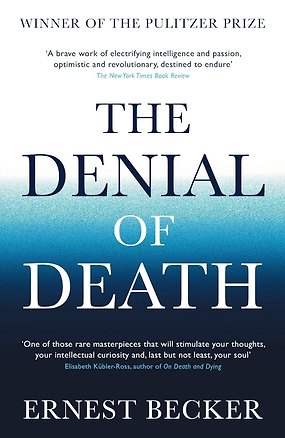
The Denial of Death (Ernest Becker)
The book argues that human civilisation is a defence against the knowledge that we are mortal beings. Becker states that humans live in both the physical world and a symbolic world of meaning, which is where our 'immortality project' resides. We create in order to become immortal - to become part of something we believe will last forever. In this way we hope to give our lives meaning.
In The Denial of Death, Becker sheds new light on the nature of humani
The book argues that human civilisation is a defence against the knowledge that we are mortal beings. Becker states that humans live in both the physical world and a symbolic world of meaning, which is where our 'immortality project' resides. We create in order to become immortal - to become part of something we believe will last forever. In this way we hope to give our lives meaning.
In The Denial of Death, Becker sheds new light on the nature of humani
The Denial of Death (Ernest Becker) Отрицание смерти (Эрнест Беккер) /Книги на английском языке
Этот товар закончился
Купили 2 человека
Описание и характеристики
The book argues that human civilisation is a defence against the knowledge that we are mortal beings. Becker states that humans live in both the physical world and a symbolic world of meaning, which is where our 'immortality project' resides. We create in order to become immortal - to become part of something we believe will last forever. In this way we hope to give our lives meaning.
In The Denial of Death, Becker sheds new light on the nature of humanity and issues a call to life and its living that still resonates decades after it was written.
Отрицание смерти (Эрнест Беккер)
В книге утверждается, что человеческая цивилизация — это защита от знания о том, что мы смертные существа. Беккер утверждает, что люди живут как в физическом мире, так и в символическом мире смысла, где находится наш «проект бессмертия». Мы творим, чтобы стать бессмертными – стать частью чего-то, что, по нашему мнению, будет длиться вечно. Таким образом мы надеемся придать нашей жизни смысл.
В «Отрицании смерти» Беккер проливает новый свет на природу человечества и призывает к жизни и ее проживанию, который до сих пор находит отклик спустя десятилетия после того, как он был написан.
- Тип обложки Мягкий переплёт
- Кол-во стр. 336
- Вес 240 г
- Год издания 2020
- Издательство Profile
- Издательский бренд Profile
- Серия Зарубежная литература (Profile)
- Автор Ernest Becker
- Размер 2x12.6x19.4
- ID товара 2890373
- ISBN 978-1-78-816426-9
- Возрастное ограничение 16+