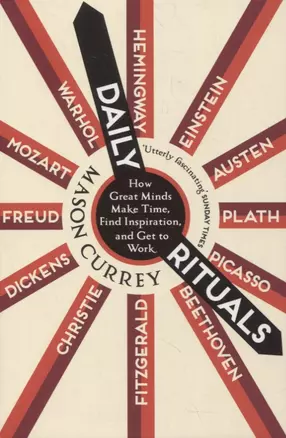
How artists work, how they ritualize their days with the comforting (mundane) details of their lives: their daily routines, fears, dreams, naps, eating habits, and other prescribed, finely calibrated "subtle maneuvers" that help them use time, summon up willpower, exercise self-discipline and keep themselves afloat with optimism.
Artists considering how they work--in letters, diaries, interviews, beguilingly compiled and edited by Mason Currey. Portraits that inspire, amuse, and delight a
Artists considering how they work--in letters, diaries, interviews, beguilingly compiled and edited by Mason Currey. Portraits that inspire, amuse, and delight a
Daily Rituals: How Artists Work
Этот товар закончился
Купили 3 человека
Описание и характеристики
Artists considering how they work--in letters, diaries, interviews, beguilingly compiled and edited by Mason Currey. Portraits that inspire, amuse, and delight and that reveal the profound fusion of discipline and dissipation through which the artistic temperament is allowed to evolve, recharge, emerge.
From Beethoven and Kafka to George Sand, Picasso, Woody Allen and Agatha Christie; from Leo Tolstoy and Henry James to Charles Dickens and John Updike, here are writers, composers, painters, choreographers, playwrights, philosophers, caricaturists, comedians, poets, sculptors, and scientists on how they create (and avoid creating) their creations.
- Тип обложки Мягкий переплёт
- Кол-во стр. 304
- Вес 216 г
- Год издания 2020
- Размер 2x13x19.5
- ID товара 2871499
- ISBN 978-1-52-905996-0, 978-1-5290-5996-0
Отзывы
Книга для тех, кому интересна биография великих людей
Интересная книга, которая содержит в себе множество глав о различных писателях, художниках, композиторах и других выдающихся личностей. Каждая глава посвящена разным людям и подробно описывает их привычки, интересы, условия, в которых они создавали свои шедевры. Книгу легко и удобно читать, она весьма компактная. Также в книге содержатся иллюстрации и фотографии известных людей и их домов, студий, и т.д.